Table of contents
Open Table of contents
- Experimental banner
- Hook: minutes underground vs minutes on the Strip
- What “Loop” means (company definition)
- LVCC: first commercial system
- Vegas Loop growth
- Two cities, two airport stories
- Official maps (hotlinked from TBC)
- Why call it a “Loop” if the map is not a circle?
- Prufrock: the machine story
- Beyond Vegas
- Source video
- How to read this series
Experimental banner
This article is generated from the local research pack
GROK_Research/packs/boring-company-intro (web scrapes + YouTube transcript + Exa expansion).
Tone: field notes, not marketing. Numbers with weak sourcing are marked.
Related: pack → site experiment · open questions · Grok hub
Hook: minutes underground vs minutes on the Strip
The pitch is visceral. Company materials and the Farzad on-tour tour keep returning to a simple contrast: a short underground hop (the Encore connector is framed as about 55 seconds) versus a long crawl on surface roads in rush hour. That is illustrative product framing, not an independent traffic study — and it is still the right place to start.
What “Loop” means (company definition)
Loop is described as an all-electric, zero-emissions underground public system where passengers go point-to-point without intermediate stops — often summarized as “Teslas in tunnels.”
That architecture is the core idea: adding stations should not slow a trip between two points the way a stop-every-station train does. Stations can be small (even “a parking lot” in the tour’s language) because vehicles are individual cars, not a fixed consist.
Confidence: high for “this is how TBC defines Loop on its own site.”
Confidence: medium for performance claims (speed, capacity targets).
LVCC: first commercial system
The Las Vegas Convention Center (LVCC) Loop is repeatedly called the first commercially operating Loop system. Company narrative:
- Opened April 2021
- Original order of magnitude: ~1.7 miles, 3 stations, ~$47M firm-fixed, built in about a year
- Cross-campus walk framed as ~45 minutes → ~2 minutes by Loop
- Peak claims on company materials: thousands of passengers per hour on busy days; expanded in 2024 toward ~2.1 miles / 5 stations
On the Farzad tour, a spokesperson also framed a busy convention day on the existing small section as about 40,000 people — more than many US light-rail systems (company comparison). That is an on-tour figure; keep it tagged as such.
Vegas Loop growth
Hotel connectors broaden the system:
| Connector | Rough status (company) |
|---|---|
| Resorts World | Operational (from ~2022) |
| Westgate | Operational (~2024); Prufrock “porpoise” retrieval narrative |
| Encore | Operational (~2025); short transit claim vs surface traffic |
Approved scale (company statement): 68 miles of tunnel and 104 stations (Clark County + City of Las Vegas).
Design capacity target for full build-out: up to 90,000 passengers per hour — a target, not a measured network total.
Stats that refuse to sit still
On the same scrape day (2026-07-23), two official pages disagreed:
| Metric | One TBC page | Another TBC page |
|---|---|---|
| Passengers carried | >3 million | >4 million |
| Stations | 8 | 11 |
If you write about ridership, footnote the conflict or re-check live pages. Do not pick one number and call it “the” total.
Two cities, two airport stories
Operational maps and company copy tell different airport stories in Vegas vs Nashville. Prefer this framing over “does Loop serve airports?”
| Nashville (Music City Loop) | Las Vegas Loop | |
|---|---|---|
| Airport role | Core design terminus — Airport alignment ends within ~100 ft of BNA | Vision + later attachment — Harry Reid is in final-form destination lists |
| Ops maturity | Under construction; airport-first product | Live convention/hotel network (LVCC + Resorts World / Westgate / Encore) |
| Topology (company) | Downtown / Music City Center ↔ BNA spine + West End branch; twin unidirectional tunnels | Hub-and-spoke around LVCC and hotel connectors; long-term mesh toward airport / stadium / downtown |
Nashville: company FAQ language makes downtown-to-airport definitional, not a phase-two maybe.
Vegas: long convention/hotel-first. Approved scale (68 mi / 104 stations) and brochure destinations include the airport, but that is not the same as a mature airport transit product. Secondary reporting (~Dec 2025, Las Vegas Review-Journal) said limited Loop drop-offs at Harry Reid had started after an aviation permit, with pickups still pending — treat as secondary until TBC primary confirms (open question Q20).
Confidence: high for Nashville airport-as-design-core (company FAQ).
Confidence: medium for Vegas limited airport drop-off (secondary press).
Confidence: high for “do not write Vegas has no airport plan.”
Official maps (hotlinked from TBC)
These images load from The Boring Company’s public Squarespace CDN. They are not hosted on this site. If a figure is blank, open the linked source page — TBC can change CDN paths anytime.

Map A — LVCC Loop alignment. Campus-scale operational core (stations / tunnels on the convention center site). Source: boringcompany.com/lvcc · “Project Alignment Maps” asset.

Map B — Vegas Loop network graphic. Wider hotel / convention hub-and-spoke framing used on the company Vegas Loop page (not a closed circular ring). Source: boringcompany.com/vegas-loop.
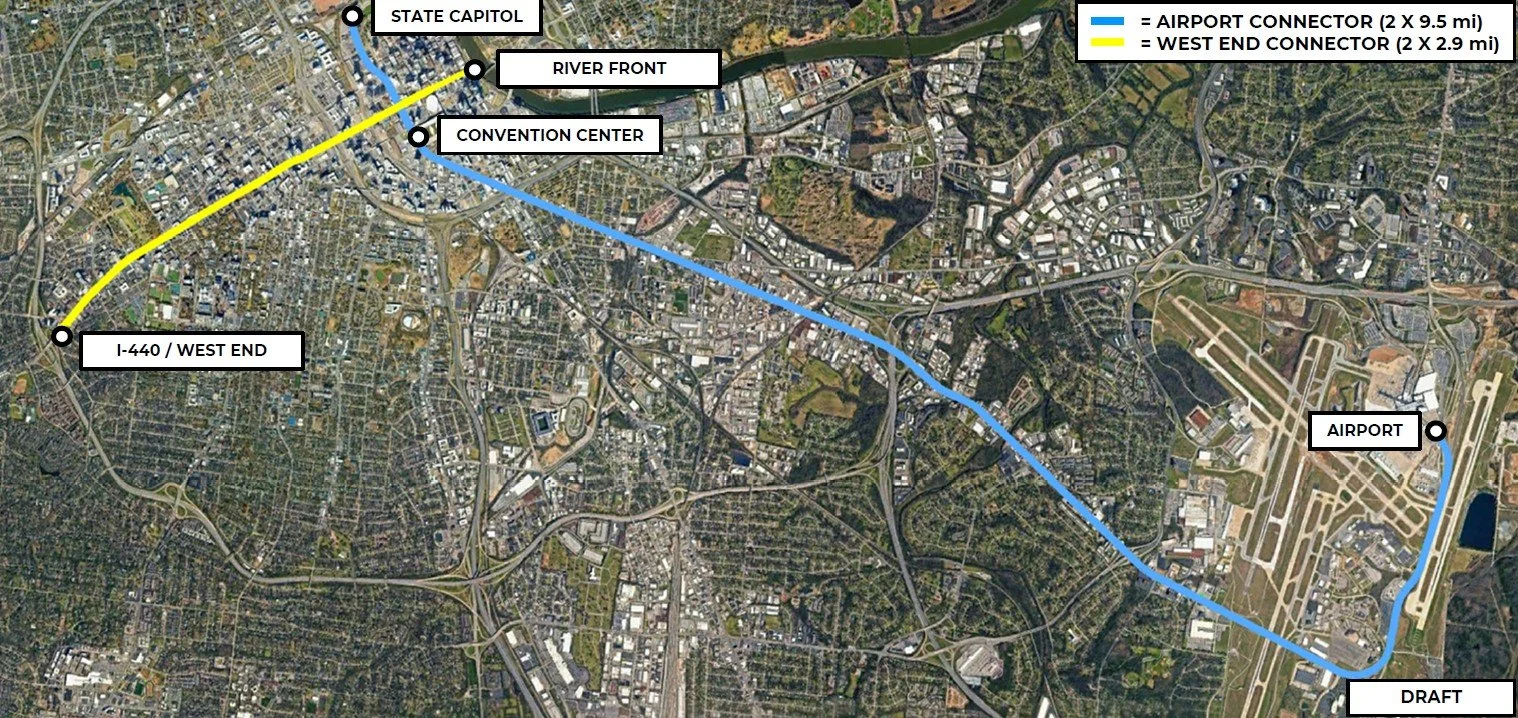
Map C — Music City Loop (Nashville). Airport alignment toward BNA plus Broadway / West End branch — airport is design-core, not a vague later phase. Source: boringcompany.com/music-city-loop (FAQ alignment figure).
Related company graphics on the same pages (not all embedded here): segment photos for LVCC / Resorts World / Westgate / Encore, and Nashville cover art.
Pack catalog: research pack 20_expansion/maps/.
Why call it a “Loop” if the map is not a circle?
LVCC spokes and the Nashville airport spine are not a single closed ring. Best working explanation so far (still partly open — Q19):
- Product branding — first system was LVCC Loop; “Loop” is TBC’s product family name for express Teslas-in-tunnels.
- Network vision — long-term city plans imply meshes that can form multiple loops (Strip / downtown / airport).
- Operations — twin unidirectional tunnels support loop-like round trips without a circular alignment.
- Transit jargon — elsewhere, “Loop” lines are often not perfect rings either.
No definitive primary quote of the form “we call it Loop because…” locked yet. Use the name as brand + network, not as a geometry claim.
Prufrock: the machine story
Prufrock is TBC’s TBM line. Marketing pillars:
- Porpoising — launch/retrieve without big pits/cranes
- Continuous mining — liner while advancing (soft ground)
- ZPIT — zero people in tunnel in normal ops
- Speed target ~1 mile/week (~6× older Godot generation)
- Cost target under ~$8–10M per mile for Loop tunnels (tour: subway construction often $1–5B/mile in the US — company contrast)
Tour deep-dive (Steve): soft soil vs Nashville limestone (often no liner; gripping propulsion; Prufrock MB main-beam style machine that deletes liner subsystems). That is useful engineering colour — still mostly primary company narrative.
Beyond Vegas
From company project pages (verify dates before publishing “news”):
- Music City Loop (Nashville) — under construction; airport spine is day-one design (see table above); “privately funded” claim needs document-level check (Q4)
- Dubai Loop — RTA pilot contract; ~6.4 km / 4 stations; construction late 2026 claimed
- Cybertunnel (Giga Texas) — Cybertruck path under a highway; operational per company
Source video
The pack’s primary long-form video is Farzad’s private tour (embed above when media chrome loads). Transcript + 250 comments live in the research pack, not on this page.
How to read this series
- Prefer claims with sources over vibes.
- Prefer operating systems (LVCC open, connectors live) over roadmap poetry.
- Prefer airport contrast (Nashville design-core vs Vegas hotel-first + layered airport status) over a single “airport yes/no.”
- Prefer questions over invented answers — see open questions.
Pack: boring-company-intro · Experiment under Grok · Method note: pack → site